
Mental health is menstrual health.
In September 2025, Beayonie Washington, a Divine Drops Menstrual Health Advocate and gifted journalist, began a powerful journey. She set out to interview period advocates and activists, gathering stories and insights about the deep connection between menstrual health and mental health.
Today, we honor her for lending her voice, her courage, and her extraordinary talent to this movement. Her work is helping shift narratives, spark conversations, and fuel a global revolution in menstrual dignity.
We invite you to dive into her blog, feel inspired, and share it with the people around you. Together, we rise.
What is the connection between menstrual health and mental health?
Mental Health is Menstrual Health.
The Divine Drop.
Women from India, Africa, North America and South America understand this connection

Mikaela Ingram, founder of Divine Drops in North America, talks about her experience of hormone imbalance, “Imagine not having reliable products, not having basic understanding or even a positive relationship with your menstrual cycle and how much that does effect your mental health, your relationship with yourself and the health of your body” It also impacted her mental health, “leading to depression and isolation,” she stated. For others, it can lead to more intense thoughts of suicide (according to Ross JM 2024).
“It can even lead to depression in situations where your career is interrupted or your period prevents
you from doing something important, like
How are mental health and menstrual health connected?“ Mental health and menstruation are inseparable,” Dr. Ooha Mahanthi, managing director for Rural Development Welfare Society RDWS in India, said. Grace Ngonyanui, founder and director of Gracious Hope Organization in Tanzania, said, “Hormonal changes during the cycle affect mood, energy levels, and emotions. Stress, anxiety, or depression can worsen period symptoms, while painful or irregular periods can also affect mental well-being. Supporting both together is important for overall health.” Both women are from different parts of the world with various backgrounds, and they concluded mental health and menstrual health are connected.
attending a meeting or showing up for an investor presentation”,
Paola Porras, Divine Drops community outreach, said.

Understanding And Respecting That Hormones Rule The Mind And Womb.
Founder Of Divine Drops Mikaela Ingram, United States Of America.

(Vashisht, Aditi; 2018) says 40% of girls miss school because of period poverty or not having products. But how many are in school, 20% more hungry in their luteal phase,school-provided lunch wasn't enough to curb their hunger, and anxious about not having reliable products? More girls and women during their luteal phase are prone to experiencing mood swings or even sugar spikes, which adds to feelings of stress and anxiety due to not having enough to eat ( Sadikshya Niroula 2024) and not having the quality tools they need.
Therefore, because mental health and menstrual health are connected for women, how many women have been misdiagnosed with a mental disorder because of a hormone imbalance? (Handy 2022) Hormone imbalances have a more detrimental impact on a woman because it affect her entire lifestyle, how she sees herself and how she shows up, whether she can move with intense cramps or being perceived as over-reacting. Due to a woman having longer hormonal phases, 28 days, rather than a man, who goes through a 24-hour hormonal phase. Women are in emotional or agitated states for longer periods of time if their hormones are imbalanced.


"Women who are not allowed into temples during this time have a different and secret relationship with God that develops.”
Grace Ngonyanui, Founder and Director of Gracious Hope Organization, Tanzania
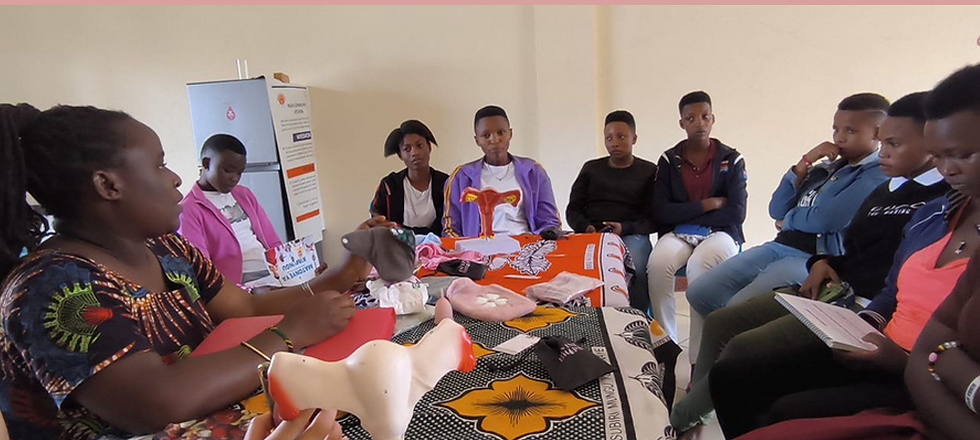
To begin to change the narrative around the menstrual cycle, women-led organizations like Divine Drops need to be able to teach hormone rebalance, create emotional support for women and how to use sustainable period products. This holistic approach helps women and girls build significantly positive relationship with their bodies and reduce hormone imbalance. Traditionally school systems have a curriculum in puberty education that doesn't teach females the details of how the fertility cycle of hormones impacts their mental health and daily life. (Schmitt 2022)
The stigma around menstrual cycles being dirty, nasty, or disgraceful has translated across the world. “All religions (excluding Sikhism) refer to menstruating women as 'ritually unclean', and the Sabarimala temple, located in the south Indian state of Kerala, banned menstruating women from entering its premises from the onset of their menarche until the time they reached menopause (Bhartiya 2013)”. Women who are not allowed into temples during this time have a different and secret relationship with God that develops. The modern world is unknown to. Into a private and sacred relationship with her menstruation.
Grace Ngonyani argues, “It has deepened my relationship with the divine. Instead of seeing my cycle as a burden, I now see it as a sacred process that connects me to creation and renewal.” Dr. Ooha Mahanthi states, “Yes. Early on, cultural messages framed menstruation as 'unclean,' and this created distance between me and the divine. But as I grew in knowledge, I began to see menstruation as part of creation itself. This realization reshaped my relationship with God—it became one of reverence and closeness, rather than guilt. Today, I see every cycle as a spiritual teacher.”
“The depth of a menstrual cycle is yet to be discovered because of this silence”
Grace Ngonyanui, Founder and Director of Gracious Hope Organization, Tanzania.

I say this to say, the depth of a menstrual cycle is yet to be discovered because of this silence. “Much of the stigma originates from patriarchal traditions, myths of impurity, and generations of silence,” Dr.Ooha Mahanthi observes. Divine Drops certifies women with the knowledge of menstrual health, to begin to understand the depth of menstrual health for future generations to come. Women-led organizations, therefore, are the only ones that are able to lead, teach, and guide through the understanding of the menstrual cycle because she has a relationship with her bleed, a sacred relationship with the divine. A healthy period supports mental health; it’s a sign of healthy hormone balance in her life, working, and playing. It is also a tool to help young girls understand their relationship with themselves and the divine.

CITED SOURCES.
Aru Bhartiya (International Journal of Social Science and Humanity, Vol. 3, No. 6, November 2013)
Bowman, Z. C. (2025). Augustana. Augustana Digital Commons. https://digitalcommons.augustana.edu/cgi/viewcontent.cgi? amp=&article=1010&context=ethicscontest From Harvard Medical School (Drs. Handy, A. B. (2022, March 4).
Psychiatric symptoms across the menstrual cycle in adult... : Harvard Review of Psychiatry. LWW. https://journals.lww.com/hrpjournal/fulltext/2022/03000/psychiat ric_symptoms_across_the_menstrual_cycle_in.2.aspx Schmitt, M. L., Gruer, C., Hagstrom, C., Ekua Adenu-Mensah, N., Nowara, A., Keeley, K., & Sommer, M. (2022, October 21).
“it always gets pushed aside:” qualitative perspective on puberty and menstruation education in U.S.A. schools. Frontiers in reproductive health. https://pmc.ncbi.nlm.nih.gov/articles/PMC9635341/ Vashisht, Aditi, Medicine, D. of C. (2018, December).
School absenteeism during menstruation amongst adolescent... : Journal of Family and Community Medicine. LWW. https://journals.lww.com/jfcm/fulltext/2018/25030/school_absen teeism_during_menstruation_amongst.4.aspx https://bpspsychub.onlinelibrary.wiley.com/doi/abs/10.1111/bjdp.12 531 Sadikshya Niroula, Shishor Paudel, Anisha Chalise, Sophiya Acharya, Nirmal Raj Marasine (2024 November 5th)
British Journal of Developmental Psychology volume 43, Issue 1)
Interviews with
Paola Porras Divine Drops Community Outreach Mexico
Grace Ngonyanui, Founder and Director of Gracious Hope Organization, Tanzania
Mikaela Ingram, Founder of Divine Drops, United States Of America
Dr. Ooha Mahanthi, Managing Director for Rural Development Welfare Society RDWS India
Download this article here
Beayonie Washington is a journalist and storyteller committed to empowering women and communities through thoughtful reporting and creative advocacy.
With a B.A. in Journalism and Media Studies from Bennett College, and additional studies in data science, global issues, and policy writing, she blends narrative, research, and visual storytelling to spark meaningful change.
Beayonie believes that imagination is a catalyst for transformation, guiding her mission to create stories that not only inform but inspire.


Comments